01
The prompt was exciting, but too open-ended to build from.
PepsiCo had fragmented pricing, margin, market, buyer, and negotiation data. Without a strong product point of view, a fast AI sprint could have produced novelty instead of utility.
Public case study preview · AI decision intelligence
I led UX strategy and the working POC, turning a broad executive prompt into an explainable decision-intelligence product for commercial negotiators.
The challenge
Pricing, margin, market, buyer, and negotiation information was fragmented. The opportunity was broad, but the product needed a clear point of view about which decisions it should improve.
Commercial teams did not need another source of information. They needed confidence about what changed, why it mattered, what move to make, and what evidence could defend it.
My role
I led UX strategy and the POC, focused the sprint on real negotiation decisions, translated user feedback into product capabilities, and prioritized what the team could responsibly validate within three weeks.
The working model gave users and partners something concrete to critique, allowing UX to shape the product thesis and roadmap before the direction hardened.
Key decisions
What changed
In three weeks, ATLAS became a functional decision-intelligence POC, a sharper product thesis, and a prioritized roadmap grounded in user feedback.
Outcome
The sprint turned design exploration into a concrete artifact the team could critique, refine, and use to make roadmap decisions. This is a product-direction outcome—not a claim of production adoption or measured business impact.
What this proves
The complete case study is protected because it contains proprietary workflows and interface details. Use the unlock panel above to view the full experience.
3-week UX strategy sprint / AI-assisted POC build
I turned a broad AI opportunity into a working product direction for commercial negotiation strategy.
Role
UX strategy + POC lead
Timeline
3 weeks
Users
Commercial negotiators
Output
Working POC + roadmap
My design position
Decision intelligence should direct human attention and explain why—not simply add another layer of data.
Demo walkthrough of the ATLAS direction: priority signals, scenario controls, buyer context, and recommended negotiation moves.
POC demo / 1.5xATLAS started as a 3-week challenge: how far can UX push an ambiguous AI opportunity when the team builds quickly, listens closely, and keeps the product grounded in real decision-making?
01
PepsiCo had fragmented pricing, margin, market, buyer, and negotiation data. Without a strong product point of view, a fast AI sprint could have produced novelty instead of utility.
02
Instead of starting with what AI could generate, I focused the team on what users needed to decide: what changed, why it mattered, what move to make, and what evidence could defend it.
03
I framed weekly user sessions around discovery, co-design, concept trust, and final validation. Research was not a checkpoint. It was the engine that kept the POC grounded while we moved fast.
04
In 3 weeks, the team moved from a broad AI idea to a functional decision-intelligence POC, a sharper product thesis, and a set of roadmap choices grounded in user feedback.
Context
Work moved across Excel, PowerPoint, SharePoint, Outlook, customer systems, commodity data, meetings, calls, and human memory.
User need
The real question was not "what does the data say?" It was "so what do we do now, and can we defend it under pressure?"
Product challenge
In a high-stakes commercial setting, a confident answer without provenance creates more risk than value.
Legacy workflow
Manual synthesis before strategy.
ATLAS workflow
Evidence-backed decisions before the room.
POC architecture / decision loop
I narrowed the POC around one repeatable decision flow: notice the change, understand the risk, compare possible moves, prepare the argument, then capture what happened so the system gets smarter.
What shifted in pricing, margin, market signals, customer ask, or source freshness?
Which negotiations are exposed, and where are target, red line, or relationship risks emerging?
Compare recommended, conservative, aggressive, and user-authored moves with tradeoffs visible.
Use buyer memory to anticipate likely objections, timing pressure, and response patterns.
Package evidence, pushback responses, and audience-safe outputs for the next conversation.
Turn negotiation outcomes into memory that informs future buyer guidance and scenario quality.
Debrief learning feeds back into buyer memory, source confidence, and the next scenario recommendation.
User feedback showed the problem was not access to more information. It was confidence in what to do next. Each major feature translated one feedback theme into a product capability.
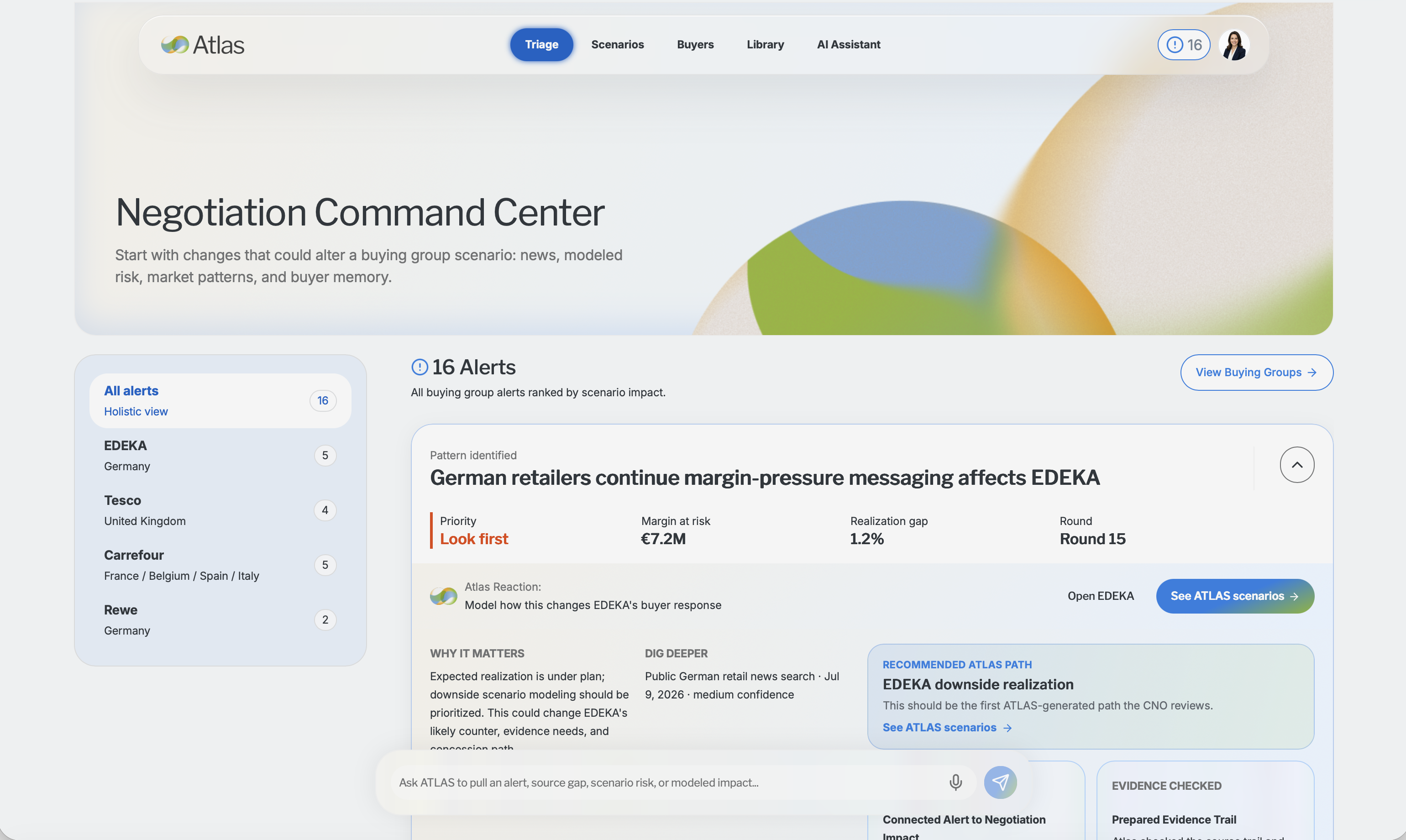
Feature 01
User insight
Users did not need another report; they needed "now what?" guidance from data.
How it shaped the build
The hub prioritized what changed, why it mattered, and what action should happen next.
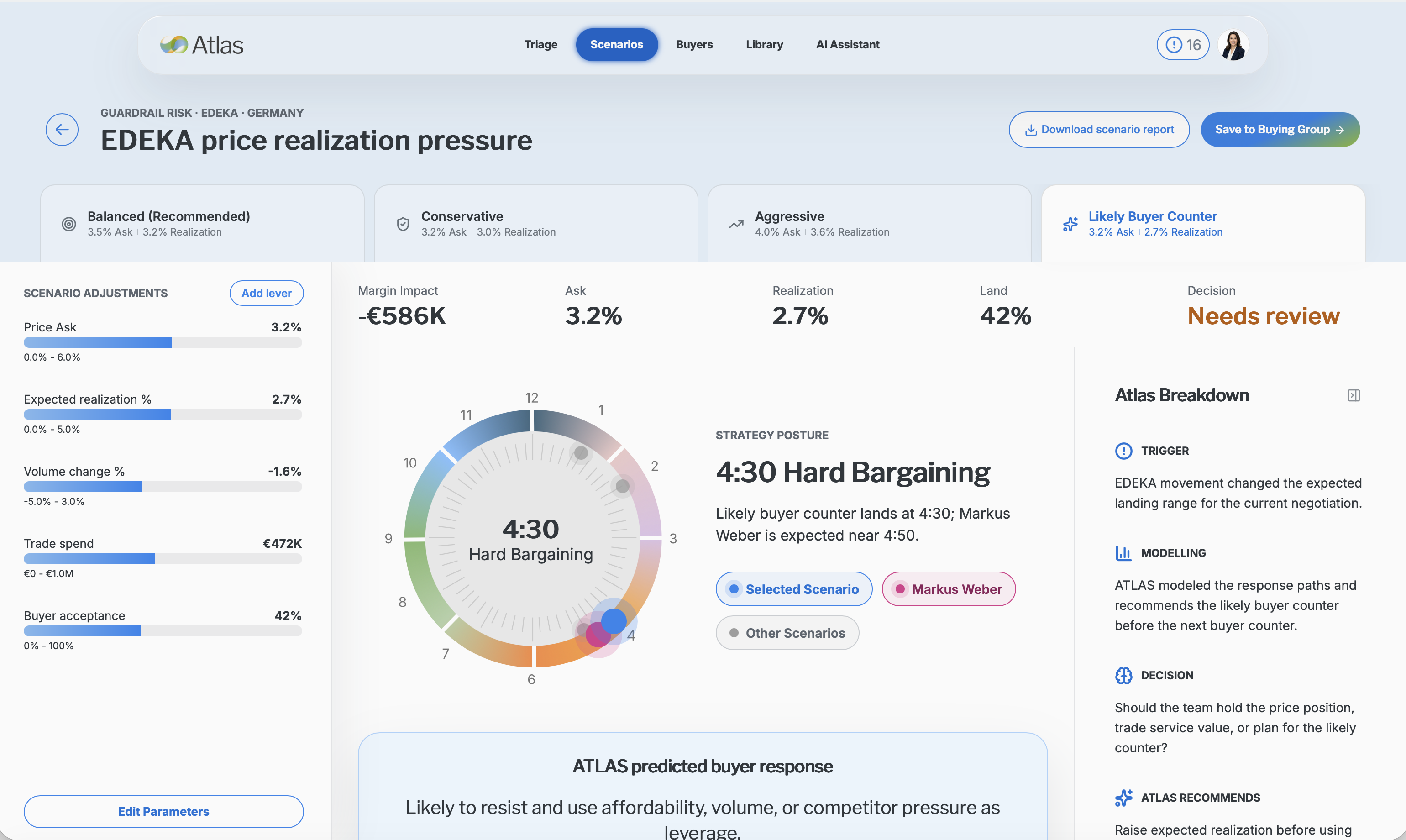
Feature 02
User insight
Scenarios need custom variables because buyer, market, and region context varies.
How it shaped the build
Editable assumptions, custom levers, and market/buyer-specific inputs let users adjust AI recommendations.
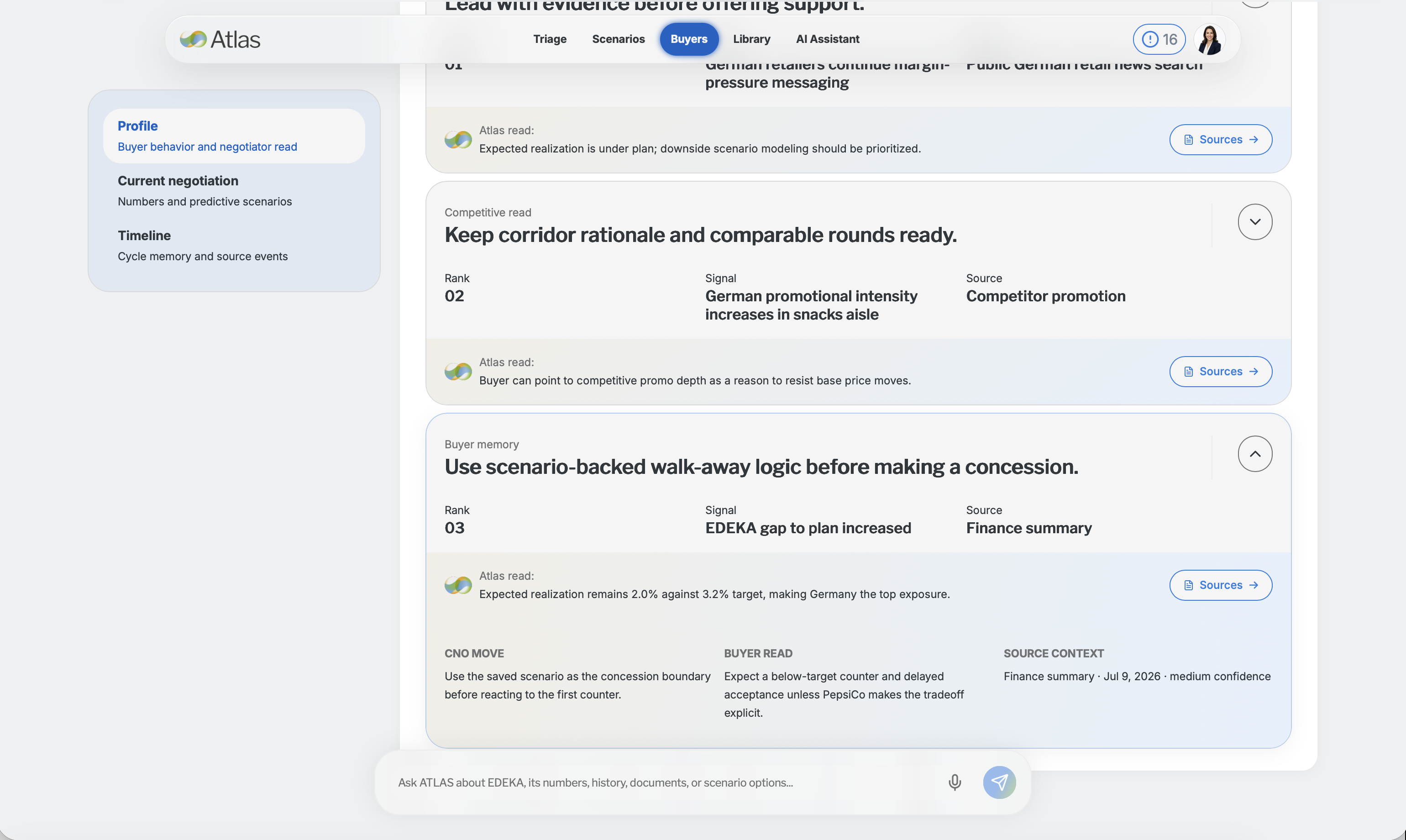
Feature 03
User insight
Buyer behavior is tracked today in spreadsheets and memory, but it is not truly intelligent.
How it shaped the build
Buying group workspaces turned history into guidance: behavior patterns, objections, handoff context, and relationship cues.
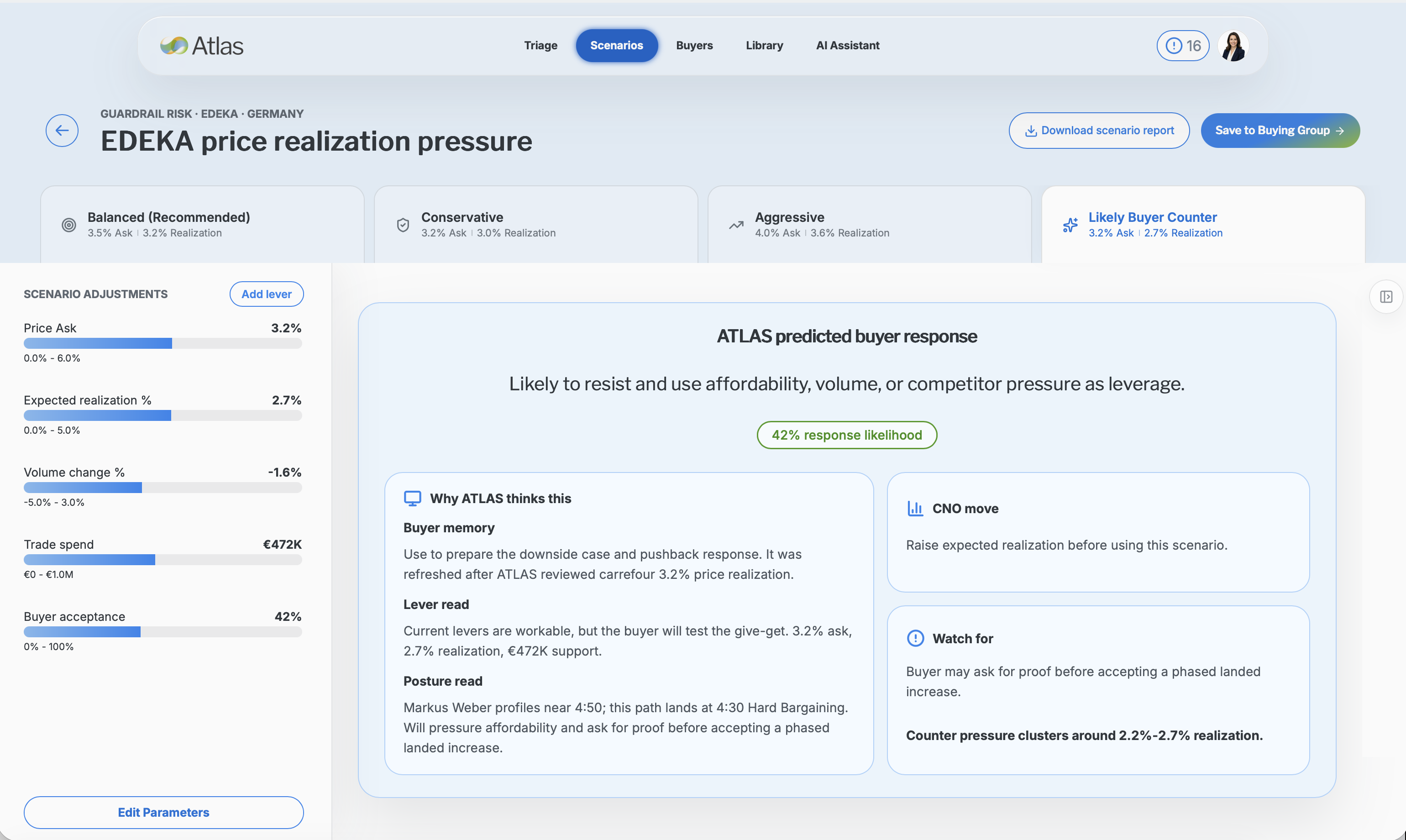
Feature 04
User insight
Negotiation prep is about building a defensible argument, not just collecting data.
How it shaped the build
ATLAS connected recommendations to proof, objection forecasts, pushback maps, and suggested responses users could bring into the room.
Prioritization under constraint
We collected more feedback than the sprint could responsibly absorb. My role was to turn that feedback into product decisions: build the capabilities that unlocked trust, decision quality, and user confidence first, then move lower-fit or higher-risk ideas into the backlog.
Used to continue the build
Feedback showed the IA was hard to scan, so the MVP shifted toward a triage-first model that made priority signals easier to find.
Every number and recommendation needed source, freshness, confidence, and known gaps, so trust became visible product behavior.
Users could only test a limited number of scenarios manually, so ATLAS focused on evaluating many paths and returning the strongest few.
Commercial negotiators were already gathering documents and reports before key conversations, so generated outputs became a practical handoff moment.
Negotiators often work with the same buyers for years, making buyer memory a core input for closed-loop recommendations.
Saved for later
High-value, but live listening introduced legal and implementation complexity that made it wrong for the MVP.
Account-manager needs were important, but the clearest first wedge was the commercial strategy workflow, with broader persona support kept in the roadmap.
Market context mattered, but research pointed to alerting and filtering as the sharper MVP expression.
Product-level and highly granular modeling were valuable, but the sprint needed to validate the core scenario engine first.
01 / Product thesis
Signal
Users did not need another report.
Move
Make ATLAS reason through risk, compare paths, and recommend next moves.
Result
A sharper product thesis the team could explain through user pressure and decision quality.
02 / Trust model
Signal
Recommendations had to be defensible to leadership, account teams, and customers.
Move
Design source labels, confidence states, assumption editing, and evidence trails into the core flow.
Result
Trust moved from explanation copy into visible product behavior.
03 / Core capability
Signal
Negotiators keep mental models of buyer behavior and relationship dynamics.
Move
Turn profiles into prediction inputs: likely objections, past-round patterns, and concession preferences.
Result
ATLAS became more than static context. It could guide strategy for the next round.
Working model
The POC also became a test of how UX designers can use AI tools and GitHub to work more like a product team: make decisions visible, build in shared code, and give engineering, product, and leadership one artifact to inspect together.
01 / Codex as build partner
Codex helped turn product decisions into functional UI quickly, making interactions, edge cases, and system logic easier to evaluate than a flat mockup.
02 / GitHub as source of truth
Using GitHub created a shared record of decisions, iterations, and implementation details, so the team could discuss the actual build instead of translating between separate design and engineering artifacts.
03 / UX closer to delivery
This model let UX explore IA, flows, states, and product logic in a format the larger team could validate, refine, and eventually hand off with less ambiguity.
Outcome
In 3 weeks, ATLAS moved from an ambiguous AI opportunity to a validated product direction, working POC, and prioritized roadmap.
Product impact
The sprint turned design exploration into a concrete artifact the team could critique, refine, and use to make roadmap decisions.
What this shows
I can lead a fast, evidence-backed POC: define the problem, prioritize scope, translate strategy into working behavior, and make the future tangible.